- Home
- Products
- Certificates
- Cooperation
- About Us
- News
- Contact
Contact


+86 188 3213 4509
Contact
+86 188 3213 4509

Industry News
Industry news
Apr. 22, 2026
In photovoltaic (PV) power systems, solar cables play a critical role in transmitting electricity safely and efficiently. However, not all cables are manufactured to the same quality standards. One of the most recognized international benchmarks for quality assurance is TÜV certification.
TÜV-certified solar cables are widely used in residential, commercial, and utility-scale solar installations because they meet strict safety, durability, and performance requirements. This certification ensures that the cables can operate reliably in demanding outdoor environments over long service lifetimes.
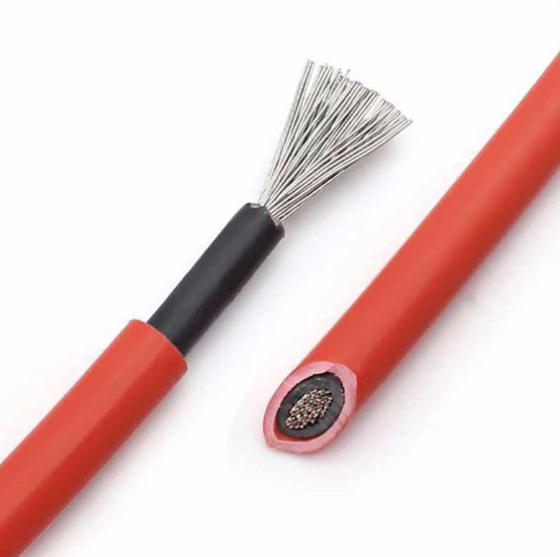
TÜV certification is issued by independent German testing organizations such as TÜV Rheinland and TÜV SÜD. It verifies that a product meets strict international standards for safety, quality, and performance.
For solar cables, TÜV certification typically follows standards such as:
IEC 62930 (photovoltaic cable requirements)
EN 50618 (low-voltage energy cables for PV systems)
These standards define requirements for electrical performance, insulation integrity, weather resistance, and fire safety.
Solar cables are exposed to extreme environmental conditions for decades. TÜV certification ensures that each cable has passed rigorous testing to guarantee long-term reliability and safe operation.
Key advantages include:
Verified product safety under high voltage DC conditions
Guaranteed resistance to UV radiation and weather exposure
Proven long-term insulation stability
Compliance with international installation standards
Reduced risk of electrical failure and fire hazards
To achieve certification, solar cables must undergo a series of strict laboratory tests covering electrical, mechanical, thermal, and environmental performance.
Cables are tested to ensure stable conductivity and insulation under DC voltage conditions.
Tests include:
Voltage withstand testing
Insulation resistance testing
Conductor resistance measurement
These tests confirm that the cable can safely transmit electricity without breakdown or leakage.
Solar cables must maintain performance under long-term high-temperature exposure.
Testing evaluates:
Insulation aging at elevated temperatures
Material stability over extended operating cycles
Resistance to thermal deformation
This ensures durability in hot climates and rooftop installations.
Since solar cables are installed outdoors, they must withstand continuous sunlight exposure.
TÜV tests simulate:
UV radiation exposure
Rain, humidity, and temperature cycling
Ozone resistance
This ensures the cable jacket does not crack, harden, or degrade over time.
Cables are subjected to mechanical stress to simulate real installation conditions.
Tests include:
Tensile strength testing
Abrasion resistance
Bending and flexibility testing
These ensure the cable remains intact during installation and long-term operation.
Safety is a critical requirement for PV systems.
TÜV certification verifies:
Flame retardancy performance
Low smoke and halogen-free properties
Self-extinguishing behavior
This reduces fire risk in both residential and industrial installations.
To meet TÜV standards, solar cables typically follow a high-performance construction design:
High-purity tinned copper
Fine-stranded structure for flexibility
Excellent conductivity and corrosion resistance
Cross-linked polyethylene (XLPE) or XLPO
High dielectric strength
UV and heat resistance
Weather-resistant, halogen-free polymer
UV, ozone, and abrasion resistance
Long-term outdoor durability
This structure ensures stable operation under harsh environmental conditions.
Choosing TÜV-certified cables provides several long-term advantages for PV system owners and installers:
Improved system safety and reliability
Extended service life (often 25+ years)
Lower maintenance and replacement costs
Compliance with international project requirements
Easier approval for global solar installations
For large-scale solar projects, TÜV certification is often a mandatory requirement for procurement and engineering acceptance.
These cables are widely used in:
Rooftop photovoltaic systems
Commercial solar installations
Utility-scale solar farms
Off-grid and hybrid energy systems
Solar energy storage connections
Their reliability makes them suitable for both small and large renewable energy projects.
TÜV certification is a key indicator of quality and safety in solar cable manufacturing. It ensures that the product meets strict international standards for electrical performance, environmental resistance, and mechanical durability.
By using TÜV-certified solar cables, photovoltaic systems can achieve higher safety levels, improved efficiency, and long-term operational stability even under challenging outdoor conditions.